- DEADLINE: from 16 September to 28 October 2026.
This post is also available in:  Français
The Québec Métiers d’Avenir Excellence Scholarship Competition 2026-2027 is now open for applications. The programme allows international applicants to fund vocational training in Quebec, Canada. It is funded by the Quebec Ministry of Education and administered by Éducation internationale through its Québec Métiers d’Avenir service. Its aim is to support the internationalization of Quebec vocational training centres (CFPs) while contributing to the development of a skilled workforce in strategic sectors across the province.
The application period for the Québec Métiers d’Avenir Excellence Scholarships 2026-2027 runs from 16 September 2026 at 12:00 noon to 28 October 2026 at 23:59, Quebec time. Selected applicants will begin their vocational training between January and December 2028.
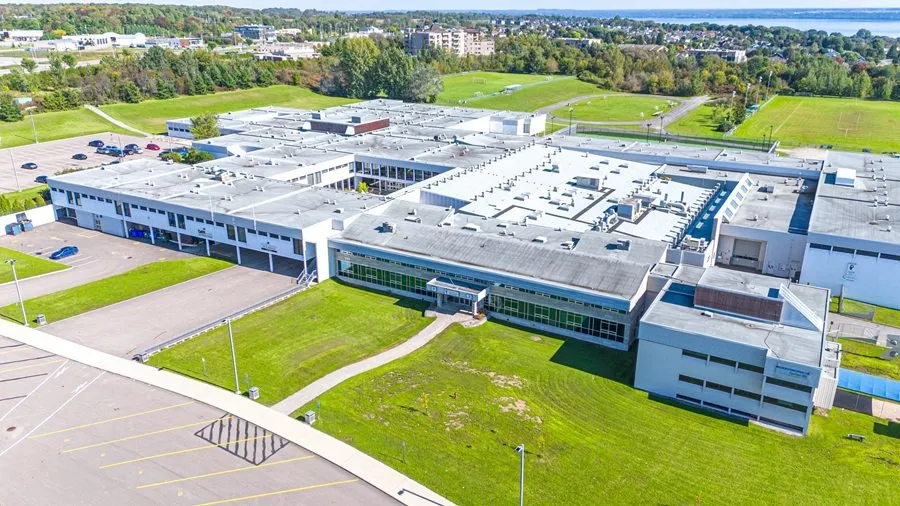 Portneuf Vocational Training Centre – Quebec, Canada.
Québec Métiers d’Avenir Scholarship at a glance
- Application period: from 16 September 2026 at 12:00 noon to 28 October 2026 at 23:59, Quebec time.
- Start of training: between January and December 2028.
- Level: full-time vocational training.
- Qualifications covered: DEP, double DEP or DEP followed by an ASP.
- Excellence scholarship amount: CAD 14,000 to CAD 26,600.
- Age: minimum 18 years old, with no upper age limit.
- Target group: international applicants of all nationalities except French and Canadian nationals.
- Location: public vocational training centres in Quebec participating in the competition.
DEP or ASP: which should you choose?
The DEP (Diploma of Vocational Studies)
The DEP is a vocational qualification lasting 1 to 2 years that prepares students to work directly in technical or skilled trades that are in high demand in Quebec, such as electricity, plumbing, cooking, welding and hairdressing. No previous knowledge of the chosen field is required: training starts from the basics and combines theory, practical workshops and workplace placements.
The ASP (Attestation of Vocational Specialization)
The ASP is a short training programme lasting approximately 3 to 6 months that allows students to specialize after completing a DEP in the same field, for example an ASP in pastry making after a DEP in cooking.



| Criterion | DEP | ASP |
|---|---|---|
| Full name | Diploma of Vocational Studies | Attestation of Vocational Specialization |
| Duration | 1 to 2 years | 3 to 6 months |
| Admission requirements | No prior knowledge required; Secondary III or IV level depending on the programme | Completed DEP in the same field |
| Objective | Learn a trade from the ground up and enter the labour market quickly | Specialize or further develop professional skills |
| Content | Theoretical courses, intensive practical training and workplace placement | Short, targeted training focused on specific skills |
| Qualification awarded | Official diploma recognized by the Quebec Ministry of Education | Official Attestation of Vocational Specialization |
| Examples | DEP in electricity, plumbing, hairdressing, aesthetics, welding | ASP in pastry making (after a DEP in cooking), ASP in home automation (after a DEP in electricity) |
The Québec Métiers d’Avenir Excellence Scholarship Competition 2026-2027 applies exclusively to programmes leading to a DEP, a double DEP, or a DEP followed by an ASP, pursued full-time at a public institution in Quebec participating in the competition. It does not fund Bachelor’s degrees, Master’s degrees or PhDs. Programmes lasting less than 900 hours are normally not eligible, except where an exception applies to certain priority programmes.
What does the Québec Métiers d’Avenir Scholarship cover?
The Québec Métiers d’Avenir Excellence Scholarship Competition 2026-2027 provides two forms of support that should not be confused.
1. The Excellence Scholarship
Applicants selected for an Excellence Scholarship receive:
- a full exemption from the additional tuition fees normally charged to international students ;
- a scholarship ranging from CAD 14,000 to CAD 26,600, calculated according to the duration of the training programme (CAD 14,000 for an eligible 900-hour programme, up to a maximum of CAD 26,600) ;
- medical coverage through the Régie de l’assurance maladie du Québec (RAMQ) during the eligible period.
2. Tuition fee exemption only
Some applicants who do not receive the monetary scholarship may nevertheless be granted an exemption from the additional tuition fees charged to international students. This option does not include a living allowance or RAMQ medical coverage.
What the scholarship does not cover
The applicant remains responsible for immigration-related costs, round-trip transportation to Canada, private medical insurance required before RAMQ coverage takes effect, educational materials, equipment or uniforms required for the training programme, and other personal settlement and living expenses.
Mandatory financial capacity
The required threshold has increased significantly for the 2026-2027 competition:
- For an Excellence Scholarship, the applicant must declare that they can access at least CAD 10,617 for their study project.
- For a tuition fee exemption only, the applicant must be able to access at least CAD 24,617.
These amounts are based on the financial requirements applicable to immigration procedures: for a single person, Quebec authorities consider CAD 24,617 necessary to cover essential living expenses for one year. The scholarship may contribute toward this amount, but it does not exempt recipients from demonstrating their own financial capacity. The required amount increases when a spouse or children accompany the student.
Who can apply?
To participate in the Québec Métiers d’Avenir 2026-2027 competition, applicants must notably:
- be at least 18 years old when submitting the application ;
- not be a Canadian citizen or permanent resident of Canada, and not have submitted an application for Canadian permanent residence ;
- not be a citizen or permanent resident of France, including the French overseas territories ;
- be outside Canada when submitting the application and remain outside Canada until the results are announced ;
- meet the admission requirements for the chosen vocational training programme and have the required language proficiency ;
- be able to meet the financial capacity requirements stated above ;
- not have previously submitted fraudulent documents under this programme or another programme run by the Ministry of Education ;
- not have paid a commission to an organization or third party for assistance with this programme.
There is no upper age limit.
Can French nationals apply?
No. French nationals are excluded from the competition because they already benefit from a tuition fee exemption arrangement under the France-Quebec agreement.
Which countries are given priority?
The competition remains open to all eligible nationalities and is not restricted to priority countries. Priority is nevertheless given to:
- member countries of the Organisation internationale de la Francophonie, with the exception of France ;
- China, Korea, India, Japan, Brazil, Colombia, the United States and Mexico.
Applicants from another eligible country may therefore still apply.
Priority training programmes in 2026-2027
A significant share of the available support is reserved for applicants choosing programmes considered priorities, grouped into four broad sectors.
Health
- Institutional and Home Care Assistance
- Pharmacy Technical Assistance
- Medical Device Reprocessing
- Health, Assistance and Nursing
Construction
- Bricklaying-masonry, insulation, carpentry-joinery, electricity, sheet metal work
- Installation and maintenance of security systems, installation of resilient flooring, installation and fabrication of glass products
- Elevator mechanics, construction equipment mechanics, fire protection mechanics
- Power line and telecommunications installation, structural and architectural assembly
- Building painting, plumbing and heating, concrete preparation and finishing, refrigeration, welding and assembly
Industry and battery sector
- Operation of mineral processing machinery, ore extraction, molten metal processing
- Electromechanics of automated systems, industrial construction and maintenance mechanics, stationary machinery mechanics
- Precision sheet metal work, machining
Aerospace and other sectors
- Manufacturing of composite industrial and aerospace parts, aerospace structural assembly, aerospace mechanical assembly
- Water treatment process operation, automobile mechanics, heavy road vehicle mechanics
Important: a programme appearing on the priority list is not necessarily offered by a particular centre under the competition. The programmes actually available are displayed directly on the platform when selecting a training programme.
Beyond these priority sectors, the competition remains open to programmes in broader fields such as administration, commerce and information technology, agriculture and fisheries, food and tourism, arts, wood, chemistry and biology, communications, environment, forestry, metallurgy and beauty care — subject to availability at the chosen centre. The official search engine can be used to check which programmes are actually offered.
Priority regions in Quebec
The administrative regions currently identified as priorities are: Bas-Saint-Laurent, Saguenay–Lac-Saint-Jean, Mauricie, Estrie, Abitibi-Témiscamingue, Côte-Nord, Nord-du-Québec, Gaspésie–Îles-de-la-Madeleine, Chaudière-Appalaches and Centre-du-Québec.
A significant share of scholarships and exemptions is awarded to priority programmes and regions, but applicants may still be selected for a non-priority programme or region when it is offered under the competition.
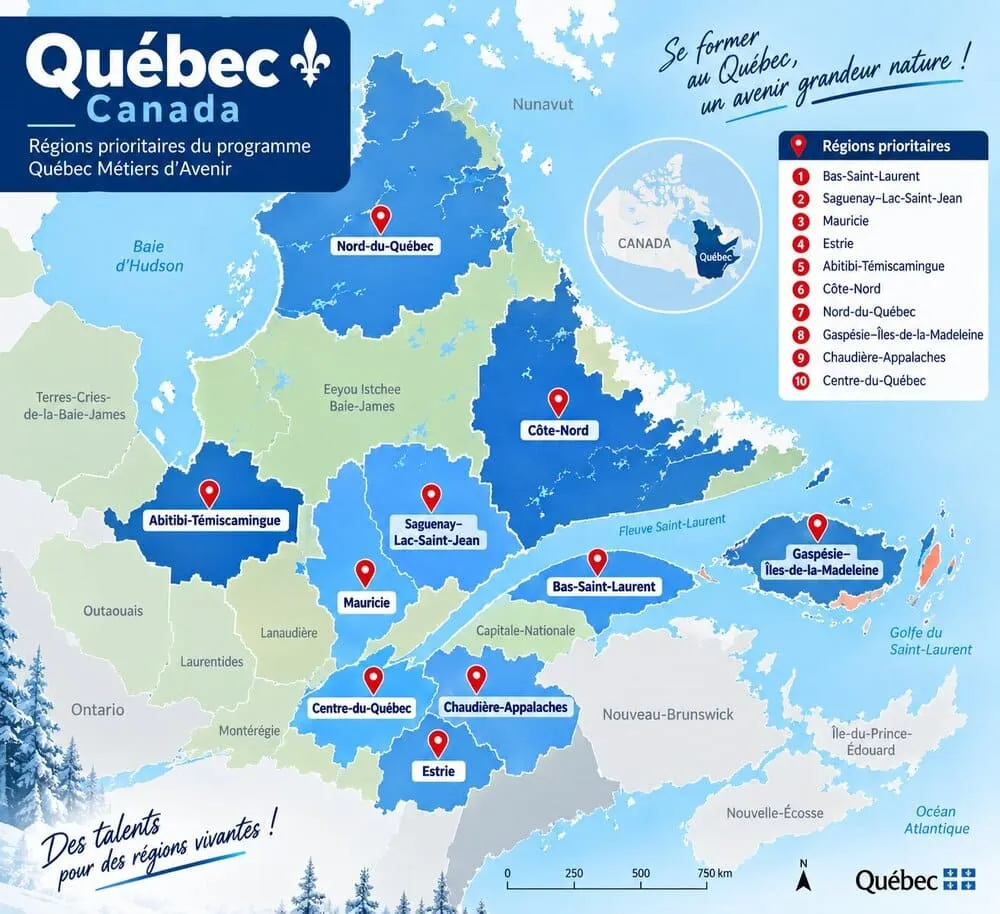 Priority regions in Quebec for the Québec Métiers d’Avenir Excellence Scholarship Competition.
Required French proficiency
Proof of language proficiency is mandatory for programmes taught in French. The level generally required is B2 or higher in each of the four language skills. Accepted evidence includes: TFL, TFI, TEF, TEFAQ, Bright Language FIVE STARS, TCF-France, TCF-Canada and TCF-Québec. The result must be less than two years old and assess all four skills.
Another option is to provide a diploma or certificate of completion together with transcripts from a higher education programme lasting at least three years and completed entirely in French (certain qualifications awarded in France or French-speaking Belgium are also accepted). Being from a country where French is an official language does not automatically exempt an applicant from providing proof of language proficiency.
What about a programme taught in English?
Applicants must demonstrate their language proficiency through a TOEFL iBT or IELTS result less than two years old (B2 level or higher in all four skills), or through at least three years of higher education completed entirely in English. One exception applies: the English-language Health, Assistance and Nursing programme also requires proof of French proficiency.
Can the language test be taken after the deadline?
An applicant who does not yet have their result may, under certain conditions, declare that they will take an approved test and submit the result later. The official documents currently differ on this deadline: the registration page states 13 November 2026, while the Guide and FAQ state 20 November 2026 at 23:59. As a precaution, applicants are advised to submit the result no later than 13 November 2026, unless further official clarification is issued.
How to apply to Québec Métiers d’Avenir?
| Important: the application is completely free and must be submitted directly by the applicant, without an intermediary or third party. |
- Check that you meet all eligibility criteria.
- Create your account on the official competition platform.
- Complete your personal profile.
- Open an application in the section dedicated to the Excellence Scholarship Competition.
- Choose one training programme and one vocational training centre only from this list.
- Complete the application form directly online and upload all required documents.
- Carefully review the application, then submit it before 28 October 2026 at 23:59, Quebec time.
Once the application has been submitted, documents and answers can no longer be changed — except for applicants who declared that they were awaiting a language test result, who have a dedicated section in which to add it. No change of training programme or centre is permitted after the applicant has been selected.
Required documents
- Identity documents: copy of the passport identification page (or national identity card in certain cases) and a copy of the original birth certificate ;
- Online form: eligibility declarations, commitments, motivations and interests relating to the study project, professional background ;
- Academic documents: diplomas or certificates of completion and transcripts from relevant secondary, vocational, technical and/or higher education studies ;
- Proof of language proficiency according to the language of instruction of the chosen programme ;
- Two reference forms completed by two different people ;
- Where applicable, proof of a maximum of two prizes or distinctions.
Documents must be written in French or English; any document in another language must be translated by an accredited translator.
Who can provide the references?
The two referees must know the applicant in an academic or professional context and be able to comment on their qualities and potential. Family members and close friends cannot act as referees, even if they are also the applicant’s employer.
How are applications selected?
Applications are first reviewed and pre-selected by the vocational training centres, after which Québec Métiers d’Avenir carries out the final selection. The official scoring system is divided as follows:
- Motivation and interests: 30%
- Academic background: 30%
- References: 15%
- Overall quality of the application: 20%
- Prizes and distinctions: 5%
Prizes and distinctions are optional: applicants who do not have any may still apply, but they will not receive points for this part of the assessment grid.
When will the results be announced?
- 25 January 2027: first selection round.
- 1 March 2027: second round and notification of unsuccessful applicants.
Selected applicants have 30 days to accept the financial support, sign the required commitments and complete their support file. Immigration procedures then begin from March 2027; Québec Métiers d’Avenir assists successful applicants with admission, immigration and preparation for their stay.
CAQ and study permit
Being selected for the scholarship does not exempt recipients from Canadian immigration procedures. Before coming to study in Quebec, the recipient must obtain a Quebec Acceptance Certificate (CAQ) for studies, followed by a Canadian study permit. The cost of these procedures is not covered by the scholarship.
Can students work during their training?
International students who meet the conditions set by Immigration, Refugees and Citizenship Canada (IRCC) may work off campus for up to 24 hours per week during regular academic sessions, and full-time during officially scheduled school breaks, provided all IRCC requirements are met. This right depends on the study permit, the student’s status, institution and programme — it is not an automatic benefit of the scholarship itself.
Post-Graduation Work Permit (PGWP): pay attention to the rules
A programme lasting 900 hours or more may meet one of the criteria for applying for a post-graduation work permit in Canada, but duration alone is not sufficient. Graduates must have completed an eligible programme at an eligible designated learning institution and meet all other rules in force at the time of application — including language requirements and, in some cases, field-of-study requirements. Since recipients of this scholarship competition will begin their studies in 2028, immigration rules may change again before they graduate: applicants are advised not to choose a programme on the assumption that it will automatically qualify them for a post-graduation work permit.
Support for scholarship recipients
Beyond the funding itself, each vocational training centre (CFP) may offer personalized welcome and support services to selected students:
- Pick-up at the airport, bus station or train station to make arrival easier ;
- Booking temporary accommodation before arrival and assistance with finding permanent housing ;
- A buddy programme with a Quebec student, with monthly follow-up throughout the training period ;
- Practical city tours, assistance with initial essential purchases, and connections with local support organizations ;
- Integration services for family members when the student arrives with dependants.
Important dates
- 16 September 2026 at 12:00 noon: applications open.
- 28 October 2026 at 23:59: application deadline.
- 23 November 2026 – 15 January 2027: application assessment.
- 25 January 2027: first round of results.
- 24 February 2027: final response deadline (first round).
- 1 March 2027: second round of results.
- 31 March 2027: final response deadline (second round).
- From March 2027: immigration procedures for recipients.
- January – December 2028: arrival in Quebec and start of training.
A free and personal application
| Applying to the competition is completely free. No commission should be paid to an organization or third party for assistance under the programme. |
Someone close to the applicant may help them understand the procedure, but the applicant must remain the author of their own application. Québec Métiers d’Avenir states that it gives preference to applications completed independently.
Contact
Questions about the competition may be sent to the Québec Métiers d’Avenir team at the official address listed in the Applicant Guide: [[email protected]](mailto:[email protected]), or through the online contact form. Before writing, applicants are advised to consult the Instruction Guide and the 2026-2027 Frequently Asked Questions, which explain the language rules, documents, references, financial capacity requirements and selection process in detail.
READ ALSO:
McCall MacBain Scholarships at McGill University in Canada
Official call Our Facebook page Our Instagram page


[email protected]
Iam Antony kimathi looking for a scholarship