ERASMUS MUNDUS NOHA SCHOLARSHIPS 2027-2029
- Deadline : 15 December 2026.
This post is also available in:  Français
Applications for the Erasmus Mundus NOHA Joint Master are now open for the 2027-2029 cohort. Applicants wishing to be considered for an Erasmus Mundus scholarship must submit their application no later than 15 December 2026 at 23:59 GMT.
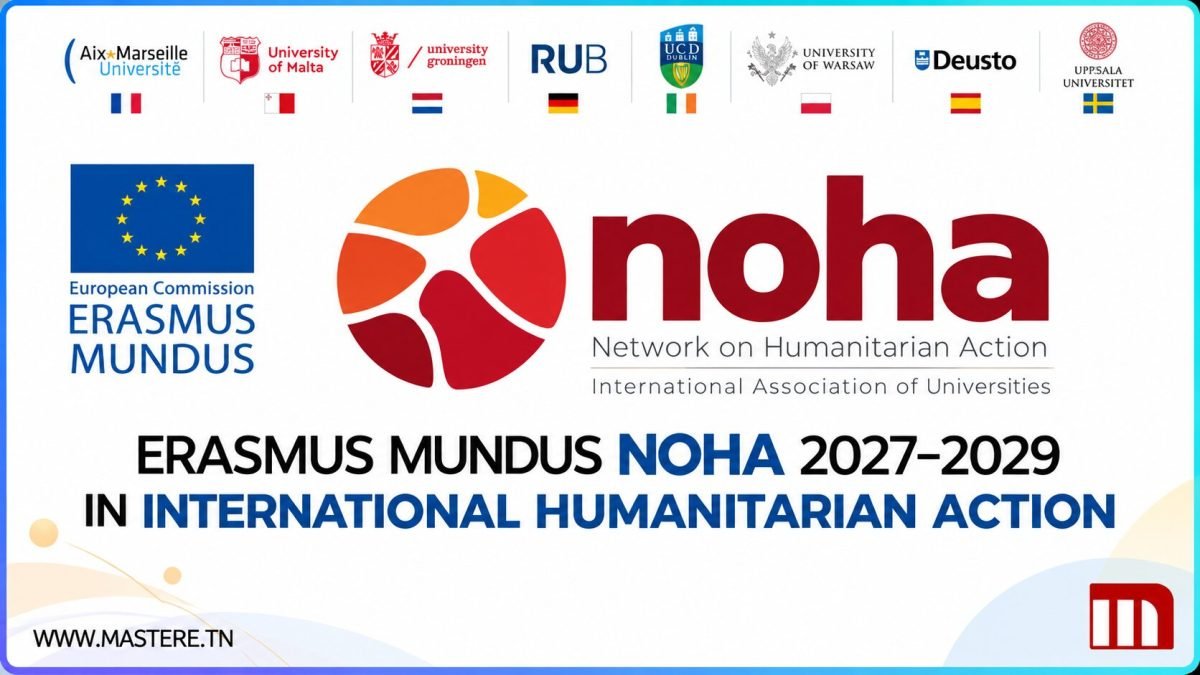
The NOHA programme is an international Master’s degree in International Humanitarian Action lasting two years and worth 120 ECTS credits. The programme is offered by eight European universities located in France, Malta, the Netherlands, Germany, Spain, Ireland, Poland and Sweden, together with an additional network of eleven partner universities around the world. It is open to applicants of all nationalities who hold a Bachelor’s degree relevant to humanitarian action.
For the 2027-2029 cohort, NOHA announces 16 Erasmus Mundus scholarships: four for applicants from “Programme Countries”, eight for “Partner Countries” and four additional scholarships targeting certain priority regions. Each recipient receives €1,400 per month for a maximum of 24 months, amounting to up to €33,600, while mandatory programme participation costs may not be charged to Erasmus Mundus scholarship holders.
NOHA PROGRAMME DESCRIPTION
The NOHA programme is an inter-university and multidisciplinary programme designed for students and professionals who wish to work in humanitarian action, crisis management, international organizations, NGOs, public agencies, research or international cooperation.

Created in 1993, NOHA was one of the first Master’s programmes selected under the Erasmus Mundus programme. The programme has again received Erasmus Mundus funding for new cohorts, notably allowing scholarships to be awarded during the current funding period.
RESPONSIBLE CONSORTIUM
The NOHA Master’s programme is currently delivered by eight European universities:
- Aix-Marseille Université — France;
- University of Malta — Malta;
- University of Groningen — Netherlands;
- Ruhr-Universität Bochum — Germany;
- Universidad de Deusto — Spain;
- University College Dublin — Ireland;
- University of Warsaw — Poland;
- Uppsala University — Sweden.
The NOHA network also includes several partner universities in Africa, Asia, the Middle East, the Americas, Australia and other regions, particularly for the programme’s third semester.
AVAILABLE TRACKS AND SPECIALIZATIONS
The second semester is the programme’s main period of academic specialization. Each student leaves their home university and joins another NOHA university offering a specific specialization.
Eight specializations are currently available:
- Legal and Geopolitical Approach of Humanitarian Action — Aix-Marseille Université, France.
- Resilience: Localising the Aid Effort — University College Dublin, Ireland.
- Forced Migration and Human Security — University of Malta, Malta.
- Humanitarian Analysis and Intervention Design — University of Groningen, Netherlands.
- Humanitarian Policy and Practice: From Delivering Aid to Ending Needs — Ruhr-Universität Bochum, Germany.
- Armed Conflicts and Humanitarian Action — University of Warsaw, Poland.
- Protection in Humanitarian Action — Universidad de Deusto, Spain.
- Conflict, Peace-building and Religion — Uppsala University, Sweden.
MOBILITY WITHIN THE NOHA PROGRAMME
The NOHA programme takes place over 4 semesters and gives students considerable flexibility:
- Semester 1: Students choose their home university when applying.
- Semester 2: Students rank partner universities for mobility and choose one of the 8 specializations.
- Semester 3 (30 ECTS): Students choose between Regional Training (study at a partner university outside the EU from a range of destinations) or a Work Placement (training and a professional humanitarian internship).
- Semester 4 (30 ECTS): Students write their Master’s thesis after returning to their home university.
DEGREE AWARDED
Students who successfully complete the 120 ECTS credits receive the: NOHA Joint Master’s Degree in International Humanitarian Action.
The programme leads to a joint degree accompanied by a joint Diploma Supplement. The qualification is jointly recognized within the NOHA academic consortium.
ERASMUS MUNDUS NOHA SCHOLARSHIPS 2027-2029
For the 2027-2029 cohort, NOHA announces the following funding:
- 4 scholarships for applicants from Programme Countries;
- 8 scholarships for applicants from Partner Countries;
- 4 additional scholarships for certain regions targeted by the Erasmus Mundus programme.
This represents up to 16 Erasmus Mundus scholarships announced for this cohort.
Erasmus Mundus rules also limit beneficiaries of the same nationality to 10% of the total number of scholarships. The consortium also warns that selection is highly competitive and that successful applicants generally combine excellent academic results with relevant experience in the humanitarian field.
ELIGIBILITY CRITERIA
The NOHA programme is open to applicants of all nationalities who hold at least a Bachelor’s degree. The qualification must be in a field relevant to humanitarian action. NOHA notably lists:
- social sciences;
- humanities;
- law;
- economics and management;
- education sciences;
- engineering;
- medical sciences;
- food sciences;
- or a comparable discipline relevant to the humanitarian sector.
APPLICATION FOR ERASMUS MUNDUS NOHA SCHOLARSHIPS
Applications for both the programme and the scholarship are submitted through NOHA’s Joint Application System. The Erasmus Mundus application period for 2027-2029 runs from: 1 October to 15 December 2026.
Applicants do not need to apply separately to each of the eight universities. They complete one NOHA application form and then rank their preferred universities for:
- the first semester – Home University;
- the second semester – Host University.
Applicants must rank all eight institutions. Final allocation takes these preferences into account, but the first choice is not guaranteed.
Required documents
The 2027-2029 application form notably requires:
- a copy of a valid international passport;
- a copy of the Bachelor’s degree certificate;
- the Bachelor’s academic transcripts;
- the Diploma Supplement, where available;
- the Master’s degree certificate and transcripts, if the applicant already holds a Master’s degree;
- a CV in English, preferably in Europass format;
- official proof of the required language proficiency;
- two letters of recommendation in English;
- proof of residence meeting Erasmus Mundus requirements;
- the applicant’s publications, where applicable.
Degrees and transcripts not issued in English must be accompanied by an official English translation.
SELECTION PROCESS
The Erasmus Mundus selection process takes place in several stages. Administrative teams first verify whether the application is complete and meets the minimum eligibility requirements.
The NOHA committees at the different universities then carry out an initial assessment before the Joint Admissions Board, comprising representatives from the consortium universities, adopts the final list.
Selection criteria notably include:
- the quality and level of academic qualifications;
- research experience;
- professional experience, particularly in humanitarian action;
- motivation and demonstrated interest in humanitarian issues;
- language skills;
- letters of recommendation;
- the results of a possible interview;
- nationality and gender balance.
Erasmus Mundus scholarship results are expected to be communicated by the end of March 2027. Rejected applicants may submit an appeal within seven days of receiving the decision.
IMPORTANT DATES
- 1 October 2026: applications open for the 2027-2029 cohort;
- 15 December 2026 at 23:59 GMT: Erasmus Mundus scholarship deadline;
- early January 2027: expected notification of applications deemed ineligible;
- end of March 2027: expected Erasmus Mundus selection results;
- 1 April 2027: central deadline indicated for self-funded applicants;
- 1 July 2027: deadline indicated for certain non-EU applicants without a valid European residence permit;
- September 2027: programme begins;
- 2027-2029: cohort duration, representing four semesters and 120 ECTS credits.
CONTACT AND INFORMATION
For questions about applications, eligibility criteria or the programme structure, applicants can contact the NOHA Master’s Secretariat: [email protected]. Applicants should also consult the specific national requirements before selecting their universities. Some institutions impose additional formalities concerning degrees, transcripts, visas or proof of financial resources.
Official call Our Facebook page Our Instagram page