DESY Summer Student Programme 2026 in Germany

- 31 January 2026.
This post is also available in:  Français
What if you spent your summer 2026 immersed in one of Europe’s largest research laboratories? The DESY Summer Student Programme 2026 at the Deutsches Elektronen-Synchrotron (DESY) invites students in physics and related fields for a seven-and-a-half-week research stay (from 21 July to 10 September 2026). The scholarship provides €28.50 per day, free accommodation at the DESY Hostel, and a partial travel reimbursement. Applications are open from 12 December 2025 to 31 January 2026.
The DESY programme at a glance
- Deadline: 31 January 2026.
- Level: late Bachelor’s (final year) or early Master’s.
- Funding: €28.50/day (~€1,482 for 52 days) + partial travel reimbursement up to €845 + accommodation.
- Location: Hamburg or Zeuthen, Germany.
- Target group: students in physics, natural sciences, or computer science, with strong English skills and basic computing experience.
About the DESY programme
DESY is a research center within the Helmholtz Association and is globally recognized for its particle accelerators. Every summer, it welcomes students from around the world to introduce them to research in a high-level scientific environment. The Summer Student Programme 2026 runs from 21 July to 10 September 2026 and lasts 7.5 weeks. Selected students join research teams in Hamburg or Zeuthen and contribute to projects in particle physics, photonics, astrophysics, or accelerator technologies.
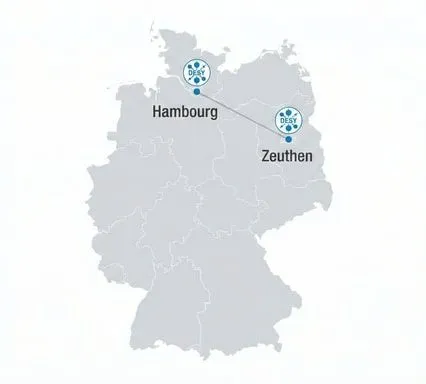 Location of the two DESY sites in Germany.
The programme combines lab work with a series of lectures in English. Participants work 39 hours per week and receive a certificate equivalent to 10 ECTS. Beyond the scientific experience, DESY organises tours of the accelerators and the computing centre, fostering genuine international networking.
Financial and practical benefits
- Daily allowance: €28.50 for the 52 programme days, i.e., about €1,482, paid in three instalments.
- Free accommodation: a single room at the DESY Hostel with a private bathroom, bed linen, and access to a shared kitchen.
- Travel reimbursement: a flat €125 is paid to all students. For costs above €300, 80% of expenses beyond €300 are reimbursed after arrival, up to a total reimbursement that can reach €845.
- 10 ECTS certificate: issued at the end of the programme, adding value to your academic profile.
Who can apply to the DESY programme?
- Required level: you must have completed at least three years of university studies in physics, natural sciences, or computer science by summer 2026. The programme targets late Bachelor’s and early Master’s students. Master’s graduates are not eligible.
- Eligible fields: physics, photonics, nanosciences, molecular sciences, astrophysics, scientific computing.
- Accepted nationalities: open to international students.
- Academic criteria: strong grades in physics or related subjects and solid motivation for research. Good English proficiency is essential, and basic computing skills are required.
- Other conditions: you must be enrolled at a university throughout the programme period and must not have been a DESY summer student before.
How to apply: step-by-step guide
Before applying to the DESY 2026 programme, make sure you meet the eligibility criteria. Then gather the required documents:


- Curriculum vitae in tabular format (1–2 pages).
- Transcripts and diplomas.
- For non-EU/EEA applicants: a copy of a valid passport, proof of enrolment covering the full period (21 July – 10 September 2026), and a Declaration of enrolment certificate signed by your university.
- One recommendation letter to be submitted via the DESY system.
- A motivation letter (maximum 1,000 characters) describing your research interests and motivation.
Once your documents are ready, access the online application form here: https://ias.desy.de/. Make sure you submit your application before 23:59 (Central European Time) on 31 January 2026.
The selection process takes place in February and March 2026. You will receive a notification from DESY by the end of March 2026. Supervisors may contact you for an interview or additional questions.
If you are accepted, start your visa process if needed (DESY will send an invitation letter that you must present at the embassy).
Timeline
- Applications open: 12 December 2025
- Application deadline: 31 January 2026
- Selection/interviews: February – March 2026
- Results notification: end of March 2026
- Programme starts: 21 July 2026
- Programme ends: 10 September 2026
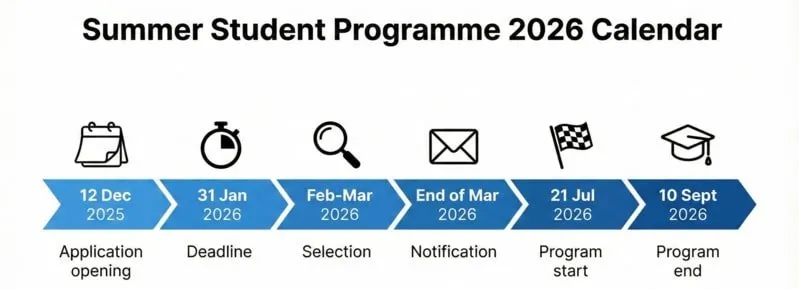 DESY Summer Student Program 2026 Calendar.
Our tips to maximize your chances
- Tailor your motivation letter to the programme: explain why you want to work in areas A, B, M, or C. Show that you understand the projects (photon science, particle physics, accelerators, or astrophysics) and that you have relevant skills.
- Highlight your computing skills: Python, C++, Matlab, and numerical simulation are appreciated. Mention them clearly in your summary and CV.
- Choose your three categories strategically: diversify (e.g., A5, B1, C1) to increase your chances. Some categories (B1, B2) offer more projects.
- Contact your referee early: the quality and timeliness of the recommendation letter can make a real difference. Make sure your referee understands the DESY programme.
- Prepare your administrative documents: valid passport, enrolment certificates, and university-signed forms. Administrative delays are common—plan ahead.
- Work on your English: lectures and lab life are in English. Practise scientific communication (presentations, technical discussions).
- Showcase your past experiences: internships, university projects, scientific clubs, or hackathons. Demonstrate that you can work in a team and manage a project.
- Follow formatting rules strictly: tabular CV, combined PDF documents, and respect the 1,000-character limit for the motivation text. Not following instructions may lead to your application being rejected.
Useful contact
For any questions or information requests, contact [email protected].
To discover more scholarships and study-abroad programs, explore our website further and stay informed about opportunities for Tunisian and French-speaking students.