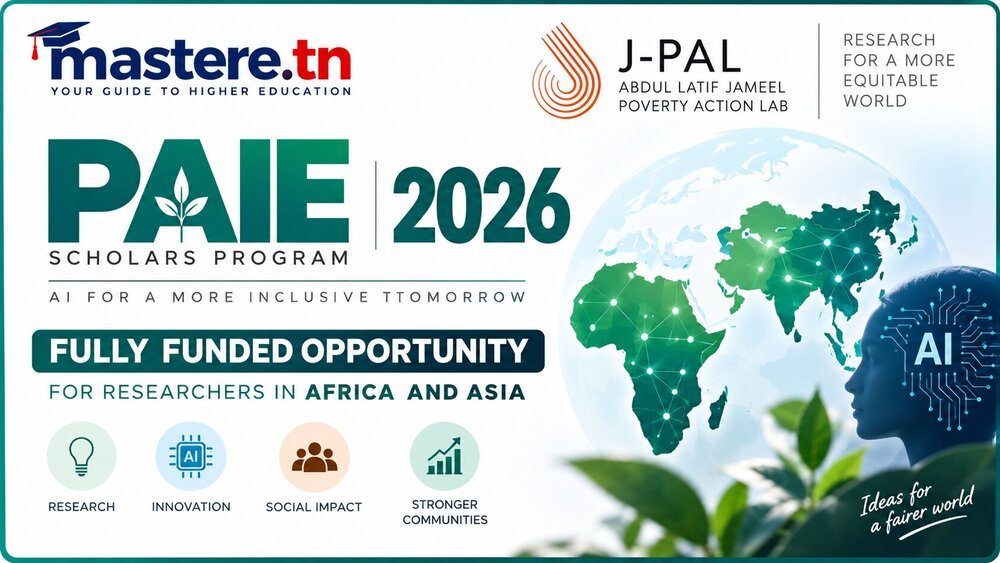
PAIE Scholars Program 2026 for low and middle-income countries in Africa and Asia
- Deadline: October 16, 2026.
This post is also available in:  Français
Applications for the PAIE Scholars Program 2026 from the Abdul Latif Jameel Poverty Action Lab (J-PAL) are now open to researchers based in low- and middle-income countries in Africa and Asia who wish to develop research on the use of artificial intelligence to address social and economic challenges.
The PAIE Scholars Program 2026 is intended for researchers who already hold a PhD and whose primary professional affiliation is with a university in an eligible country. Selected participants will first complete approximately three months of training on randomized evaluations and the evaluation of AI-enabled interventions. Those who successfully complete this first phase will receive USD 1,000. A subset of researchers may then receive up to USD 10,000 to develop their project and prepare a pilot study, before applying for funding of up to USD 75,000. The application deadline is 16 October 2026 at 12:00 noon U.S. Eastern Time (ET).
PAIE SCHOLARS PROGRAM DESCRIPTION
The PAIE Scholars Program is run by Project AI Evidence (PAIE), a J-PAL initiative focused on generating scientific evidence on artificial intelligence applications that can improve social and economic outcomes and contribute to poverty reduction.
The programme does not immediately fund a large-scale field study. It first supports researchers in transforming a preliminary research idea into a project that could lead to a rigorous randomized evaluation.



Applicants therefore submit an initial working concept note from the outset. After admission, they refine it during the training, further developing the research question, the AI-enabled intervention, the outcomes to be measured and the future evaluation design.
This structure is particularly well suited to researchers who have a promising idea but have not yet developed the full experimental protocol.
WHO CAN APPLY?
The PAIE Scholars Program 2026 is intended for resident researchers based in low-income or middle-income countries in Africa and Asia, according to the classification used by the World Bank.
For this call, J-PAL defines a resident researcher as a researcher who:
- has already obtained a PhD ;
- has a primary professional affiliation with a university located in an eligible country ;
- and is personally based in one of those countries.
Researchers may simultaneously hold positions in other organizations, but their primary affiliation must remain with a university located in an eligible country.
The definitive list of eligible countries is available through the official programme page.
ELIGIBILITY CRITERIA
Applicants must:
- have completed a PhD in economics or another relevant empirical discipline ;
- have advanced training in quantitative methods ;
- have skills in areas including statistics, econometrics, causal inference, experimental methods, machine learning or comparable methodological fields ;
- demonstrate a genuine interest in evaluating the effects of AI-enabled interventions on social or economic outcomes ;
- have sufficient English proficiency to follow the training, complete the assessment and produce the required work ;
- be available to participate in all mandatory components of the programme.
J-PAL does not require applicants to have previously worked with a J-PAL affiliated professor or invited researcher. No prior relationship with the J-PAL network is required to apply.
DO YOU ALREADY NEED TO HAVE A COMPLETE RESEARCH PROJECT?
No. Applicants must have an idea that is sufficiently developed to produce an initial concept note, but they do not need to have already finalized:
- the intervention to be tested ;
- the complete evaluation protocol ;
- data collection methods ;
- the final budget ;
- or all partnerships required for the study.
The programme is specifically designed to enable researchers to develop and strengthen this initial idea.
TRAINING FOR SELECTED RESEARCHERS
The first phase of the programme is expected to last approximately three months, from November 2026 to January 2027. Depending on their previous experience with randomized evaluations, participants should expect approximately 4 to 10 hours of work per week. The final schedule and modules assigned to each researcher will be communicated before the training begins.
The training includes:
- selected modules from J-PAL 102x: Designing and Running Randomized Evaluations ;
- content from the AI Evidence Playbook ;
- the AI Evaluation Playbook ;
- additional readings ;
- live online workshops focused on evaluating AI-enabled interventions ;
- a proctored assessment organized by PAIE.
The J-PAL 102x course is part of the MITx MicroMasters in Data, Economics, and Design of Policy. However, the examination organized as part of the PAIE Scholars Program is separate from the official MITx assessment.
FIRST FUNDING STAGE: USD 1,000
Researchers who successfully complete the first phase receive an award of:
USD 1,000.
To receive this amount, participants must:
- complete the assigned training activities ;
- pass the PAIE proctored assessment ;
- and submit a revised concept note that meets the programme requirements.
The USD 1,000 payment is therefore not awarded simply because an applicant has been admitted. It is conditional on successful completion of this first phase.
SECOND STAGE: UP TO USD 10,000 TO DEVELOP THE PROJECT
After the training, researchers who have met the programme requirements submit a more complete version of their concept note.
This revised version must notably describe:
- the social or public policy problem being studied ;
- the AI-enabled intervention or application ;
- the research question ;
- the population and context being studied ;
- the main outcomes to be measured ;
- the proposed data sources ;
- the pathway toward a future randomized evaluation ;
- the potential role of an implementing partner ;
- the additional work required before launching a pilot study.
J-PAL will then select a subset of researchers to receive a proposal-development and travel grant of up to USD 10,000.
What can the USD 10,000 be used for?
This funding may notably support:
- preparatory research ;
- identifying or developing a relationship with an implementing partner ;
- visits to potential future field sites ;
- assessing the availability of administrative data or existing survey data ;
- certain preliminary analyses of existing data ;
- development of the research question ;
- preparation of the evaluation protocol ;
- preparation of the budget and pilot proposal.
However, this preparation grant cannot be used to conduct research involving human participants or begin collecting data from them.
MENTORSHIP FROM J-PAL RESEARCHERS
Depending on the project’s needs and mentor availability, some recipients in this second phase may also receive scientific guidance. Mentors may be J-PAL affiliated professors or invited researchers with relevant expertise.
Mentorship may cover:
- formulating the research question ;
- experimental design ;
- collaboration with implementing partners ;
- field preparation ;
- and drafting the pilot proposal.
Support may also be provided by the PAIE team and J-PAL research teams.
THIRD STAGE: UP TO USD 75,000 FOR A PILOT STUDY
Researchers whose projects have been sufficiently developed may then be invited to submit a full proposal for a pilot study.
The maximum announced funding is:
USD 75,000.
This funding may notably be used to:
- test the feasibility of the intervention ;
- test the research design ;
- improve measurement strategies ;
- prepare operational procedures ;
- collect pilot data ;
- facilitate access to administrative data ;
- prepare for a future larger-scale randomized evaluation.
At this stage, the researcher must have identified an implementing partner and have a sufficiently advanced research design.
CAN A RESEARCHER MOVE DIRECTLY TO THE PILOT PROPOSAL?
In some cases, yes. If a researcher already has an implementing partner and a sufficiently advanced protocol, PAIE may invite them to move directly to preparing a pilot proposal without first receiving the project-development grant of up to USD 10,000.
The pilot proposal will nevertheless remain subject to the same competitive selection process.
REQUIRED DOCUMENTS
The initial PAIE Scholars Program application requires:
- a CV ;
- between one and three examples of research work completed by the applicant ;
- a short description of their research experience ;
- a description of any experience with randomized evaluations ;
- an explanation of their interest in evaluating AI-enabled interventions ;
- an explanation of their interest in the PAIE Scholars Program ;
- a working concept note presenting the research idea the applicant wishes to develop.
The concept note should notably make it possible to understand how the idea could ultimately lead to a randomized evaluation. It does not need to include a fully finalized experimental protocol at this initial stage.
Exact word limits and instructions are provided directly in the application form.
PAIE SCHOLARS PROGRAM TIMELINE
- 17 September 2026: applications open ;
- 16 October 2026 at 12:00 noon ET: application deadline ;
- early November 2026: expected selection of researchers ;
- November 2026: training begins ;
- approximately November 2026 to January 2027: first training phase ;
- PAIE assessment: date to be confirmed ;
- revised concept notes: date to be confirmed ;
- decisions on project-development grants: date to be confirmed.
The application timeline for pilot funding will be communicated later to the researchers concerned.
HOW TO APPLY?
Applications are submitted entirely online through the form specified by J-PAL.
Before beginning, applicants should prepare their CV, select their strongest research work and draft an initial version of the concept note explaining the problem being studied, the proposed use of AI and how the project could evolve into a randomized evaluation.
No J-PAL affiliated professor, mentor or implementing partner is required to submit the initial application.
CONTACT AND INFORMATION
Official information, the definitive list of eligible countries and timeline updates are published on the official PAIE Scholars Program page.
Official call Our Facebook page Our Instagram page